


Robotic Knee Replacement Surgery: Another Tool to Increase Precision and Improve Recovery for Patients with Osteoarthritis

Updated: Jul 22, 2025
Knee osteoarthritis is a common condition that affects millions of people, causing pain, limited movement, and a significant negative impact on quality of life. It occurs due to wear and tear on the joint, particularly the cartilage.
When non-operative treatments, such as lifestyle changes, medication, rehabilitation with physical therapy, and joint injections, are no longer effective, total knee replacement surgery, also known as arthroplasty, may be indicated. In recent years, the technology for performing this surgery has evolved significantly, and today we have an innovation that has significantly improved joint replacement surgeries: the use of a robot to assist the orthopedic surgeon during surgery.

What is robotic knee surgery?
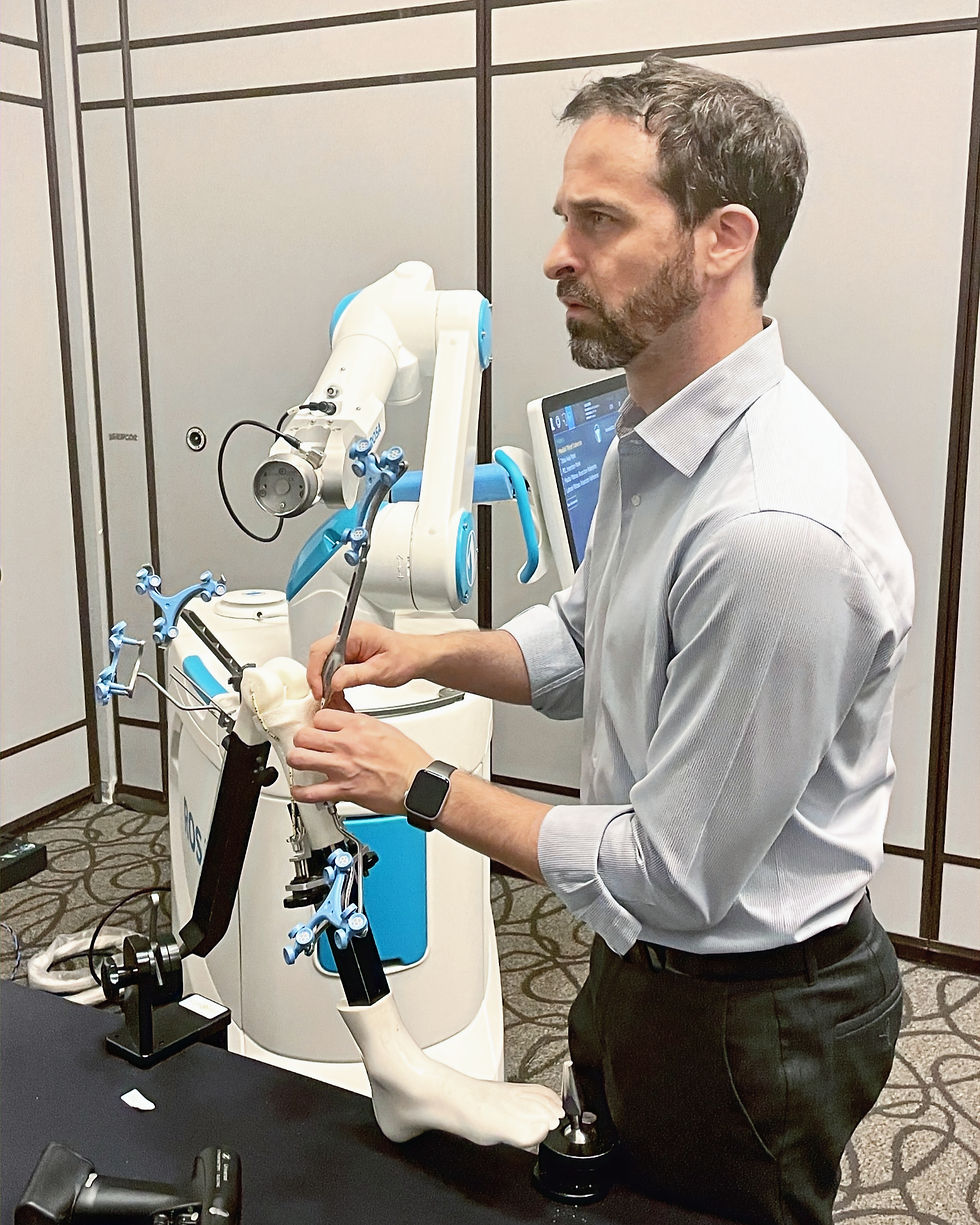
Contrary to popular belief, the robot does not perform the surgery alone. It is a high-precision tool, controlled by the surgeon, that assists in planning and executing the prosthesis customized for each patient.
Using detailed images of the knee, the robot enables the creation of a personalized surgical plan, taking into account the individual's specific anatomy. During the procedure, sensors are attached to the patient's limb, both on the femur and tibia. The robot reads these sensors to identify the patient's anatomy. Then, after some adjustments to the initial planning, a robotic arm is able to guide the tibial and femoral bone cuts, following the patient's anatomy and the planning, so that the prosthesis components are fitted precisely.
What are the benefits of robotic-assisted prosthesis?
In the medical literature, several studies show that robotic-assisted surgery can offer significant benefits to patients, such as:
• Greater precision in prosthetic positioning, which can increase implant durability and natural knee movement;
• Less impact on soft tissue, which reduces postoperative swelling and pain;
• Faster recovery in the first days and weeks after surgery.
Furthermore, personalized planning allows knee movement to be more similar to that experienced by the patient before the onset of osteoarthritis, which can facilitate a return to normal activities with greater comfort and safety.
When is this technology indicated?
Robotic surgery is primarily indicated for patients with advanced knee osteoarthritis, i.e., severe wear and tear, who require joint replacement. It is especially useful in cases with more complex deformities or bone defects, or asymmetries that hinder optimal prosthetic positioning and proper limb alignment.
The choice of robotic technique is always made on an individual basis, taking into account the clinical condition, the patient's goals, and available resources.
How much does the procedure cost?
A common question when we discuss this technique with patients in the office is whether there are any expenses beyond the conventional surgical costs.
Even patients who use their health insurance to cover hospitalization and surgical equipment costs, for example, may need to pay extra to incorporate this technology into the procedure. This happens because the devices and sensors needed for the robot to read the patient's anatomical landmarks are billed separately.
Regarding medical fees, at least in my practice, there is usually no difference between the conventional technique and the robotic-assisted technique.
Find out more
Bibliography
Marchand RC, Sodhi N, Anis HK, et al. One-Year Patient Outcomes for Robotic-Arm-Assisted Versus Manual Total Knee Arthroplasty. J Knee Surg. 2019;32(11):1063–1068.
Kayani B, Konan S, Tahmassebi J, et al. Robotic-assisted total knee arthroplasty: a systematic review and meta-analysis. Orthop Clin North Am. 2019;50(3):365–377.
Liow MHL, Xia Z, Wong MK, et al. Robot-assisted total knee arthroplasty accurately restores the joint line and mechanical axis. J Arthroplasty. 2014;29(12):2373–2377.


Comments